RIGHT AND WRONG ~ vs ~ WORKING AND NONWORKING

RIGHT AND WRONG ~ vs ~ WORKING AND NONWORKING

Recently while sitting and running a parenting group, the topic and/or question came up of “How do we start focusing on the positive rather than what’s wrong?”  This topic tends to be a general issue rather than a parent specific issue.  The issue at hand is that we spend more time focusing on what is wrong and thinking by doing this we can fix what is wrong and that our issues and troubles will be over.  The struggle is that when we spend our time on what is wrong we tend to see it as a continual stream of wrong.
I enjoy working on motorcycles. I like being able to take a motorcycle that isn’t functioning well and by process of illumination, track down what is wrong and fix it.  After stripping it down, this strategy works in helping me find the issue and putting the bike back together. The bike then tends to work more effectively. While this strategy may work on bikes, this does not work when it comes to human beings.  Human beings are more complex creatures than a simple animate object that is designed to do specific tasks. Since it tends to work well in those areas, we have the tendency to apply this philosophy to the complexity of humanity.   I cannot look at myself and simply through a process of elimination, track down one simple issue, fix it, and have my life become flawless from there forward.
There are a series of factors that play into the issues we all wrestle with.  Rather than spending our energy focusing on fixing what is wrong, there is a more effective strategy when it comes to dealing with humans and our own humanity.  One way is to simply shift our focus to look for those things that are “working” and “not working” in our lives.  When I identify the “working” pieces of my life, I can then start to see them as universal truths. I can then apply these truths not only to the issues they are working for but also use them on the things I may be struggling with.  For example, if I have the ability to let go of obsessive thoughts when it comes to work, that means I have the tools to let go of obsessive thoughts.  Therefore, if I am struggling with obsessive thoughts in my personal life, by focusing on how I am dealing with them in my work life and the processes I used to let go, I can then apply these same tools to my personal life for similar results.

We as human beings have a tendency to default to wrong and right thinking when it comes to problem solving. That may work on a carburetor; it does not work on hearts and minds of men and women.

Dean N Nixon
Seminar Director, Life Coach

Brief Motivational Interventions are Effective

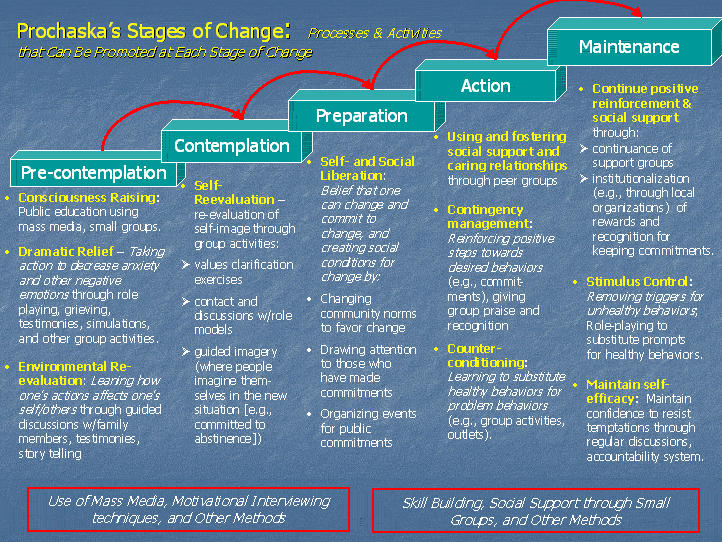
Statistics show that there is a far higher than average rate of drinking among college students, especially binge drinking. Using the Stages of Change to assess how ready a college student with a problem drinking pattern is to changing their behavior, but more importantly using motivational interviewing techniques as a brief intervention method to interrupt and change unhealthy drinking patterns was the focus in a recent study at Syracuse University (Carey, Henson, Carey, & Maisto, 2007). The efficacy of Brief Motivational Interventions (BMI) was investigated and evidence indicated that (BMI’s) reduce risky alcohol use (Carey, Henson, Carey, & Maisto, 2007).

In this study the authors hypothesized that Brief Motivational Interventions would be more effective when: 1) They were ready, according to Prochaska’s (Stages of Change) stages. 2) They had better self-regulation skills. 3)They had more awareness in social comparison. 4) They had lower present time perspective and higher future time perspective. 5) That women would be more effected by (BMI’s) (Carey, Henson, Carey, & Maisto, 2007).

The study proved that readiness for change and better self-regulation had a great effect on one’s ability to reduce the number of drinks and reduce blood alcohol content but there was no direct correlation to the use of (BMI’s) as the intervention, it was just simply that they were better at self-regulating and they were ready to change (Carey, Henson, Carey, & Maisto, 2007).

The students that were more aware of social comparison were not affected by (BMI’s), that over time their social awareness would most likely reduce consumption but not due to the intervention (Carey, Henson, Carey, & Maisto, 2007). What I found most interesting is the student’s that did not have good future time perspective were affected more by (BMI’s) than those that did. Like the intervention caused them to think of future negative consequences they had never thought of before (Carey, Henson, Carey, & Maisto, 2007). The last hypothesis that women would be more affected by the interventions was found to not be true (Carey, Henson, Carey, & Maisto, 2007).

The most important finding is that Brief Motivational Interventions will promote the reduction of drinking regardless of the student’s readiness for change (Carey, Henson, Carey, & Maisto, 2007).

In the second study reviewed the authors were exploring if (BMI’s) would have a similar effectiveness in lowering college problem gambling as it did in lowering risky drinking patterns (Petry, Weinstock, Morasco, & Ledgerwood, 2008). The study showed high rates of almost pathological gambling in college students and that 23% gamble weekly or more, and that gambling levels may be effected by Motivational Enhancement Therapy (MET) and Cognative Behavioral Therapy (CBT) interventions (Petry, Weinstock, Morasco, & Ledgerwood, 2008).

The study like the Syracuse University study on problem drinking showed that if problem gamblers where to be identified and if (BMI’s) were used it would significantly lower gambling for up to 9 months in as high as two thirds of the population (Petry, Weinstock, Morasco, & Ledgerwood, 2008).

Based on the findings of these two studies colleges need to explore the use of regular (BMI’s) for these two problem populations. The students would be more effective in school and many negative side effects from problem drinking and gambling would be reduced. As was mentioned in the study the first thing would be to identify the students currently experiencing these problems (Petry, Weinstock, Morasco, & Ledgerwood, 2008). Using the stages of change to identify those that are ready for change, and finding the student’s that already have better self-regulation skills would by the process of elimination help in identifying the remaining students with these problems that may be most affected by (BAC’s) (Carey, Henson, Carey, & Maisto, 2007).

References

Carey, K. B., Henson, J. M., Carey, M. P., & Maisto, S. A. (2007). Which Heavy Drinking College Students Benefit From a Brief Motivational Intervention? Journal of Consulting and Clinical Psychology75(4), 663-669. doi:10.1037/0022-006X.75.4.663

Petry, N. M., Weinstock, J., Morasco, B. J., & Ledgerwood, D. M. (2009). Brief motivational interventions for college student problem gamblers. Addiction. doi:10.1111/j.1360-0443.2009.02652.x

A train of thoughts — a recovering addict.

recoverymaldives's avatarrecoverymaldives

DSC_7805 © RecoveryMaldives

Is it about just life there is to it? Or, more than that? One may definitely wonder about the known and not-so-known things to life, but not the unseen aspect; just the other side of life where some of the addicts tread to. No longer content with their lives they go to unimaginable lengths to fulfill their basic need: to escape! 

But, there is a different angle to it! A more positive line of thought where the feeling of need vanishes and the feeling of giving back dominates our train of thoughts. It’s no more just about me; It’s about those around me too. How can I come to truce, where you are no longer gonna do it just for yourself but for others around you too.

There is a line, it’s still finite. Once you fall of it,  it’s going to be the end of it. That…

View original post 19 more words

Current Views On Addiction

The subject of addiction brings up many opinions and beliefs. These views on addiction can greatly affect ideas on what is addiction, if it’s possible to stop or recover from addiction, and what are the best ways to treat or overcome addiction if it is possible (Sellman, 2009). An addict, loved one of an addict, or a professional treating addiction has to wonder at times is addiction a lack of will power, a psychological or emotional issue, a chronic illness, a progressive disease, or a combination of all of the above?

Addiction comes in many forms but the process of becoming addicted and the progression of the disease has many commonalities that are better understood today than ever before. Whether the addiction is to a substance, a pleasurable activity, or a process the transition from a genetic vulnerability to a disease that changes the structure and function of the brain is similar in various ways (HMHL, 2011). First the desired subject/object/action stimulates Dopamine and other neurotransmitter activity and interaction in the brain, bringing about pleasure or reward. The speed and consistency of the result determines the strength of the connection made in between stimulus and pleasure (HMHL, 2011).  As this hedonic drive moves from desire to need the motivation to seek the pleasure is increased. Eventually this pleasure seeking mechanism becomes more of a compulsive unconscious obsession as the limbic system goes on auto pilot with the amygdala whispering heavily emotional lies about how great the pleasure really was. Even though tolerance has eroded the majority of the pleasure, many parts of the experience have become directly linked to the past pleasurable results that it triggers the frontal cortex to shut down and the limbic system to take over when triggered (HMHL, 2011).

Once one is in the trenches of addiction how can this all-encompassing subconscious automatic behavior become interrupted to the point of causing a shift in awareness or an epiphany that the strategy that once worked in finding pleasure now just brings them pain and sorrow (Sellman, 2009). When in the grip of addiction it is difficult to stop without motivators. This is not due to a lack of desire or will; it’s simply due to the fact that the majority of the pattern has become an autonomic reaction in the brain far from consciousness (HMHL, 2011).  You need to have awareness before ownership and transformation can take place. Because addiction is full of stealthy memories in the brain that have such strong emotional content that can be triggered at any minute by recalled data throughout the visual and sensory cortex, recovery will take time (HMHL, 2011).  Addicts need to move through the stages of change at their own pace based upon their own intentions and development (Sellman, 2009). New strategies and skills for self-regulation and behavioral & lifestyle modification will be the most important parts of that development.

All forms of therapy get results (Sellman, 2009). Like the law of inertia the addict will need to put apposing energy, time, and work into moving in a new direction. Energy equal to what they put into obsessing about, seeking, and using that which they were addicted too. There is not one answer for all alcoholics and addicts (Sellman, 2009).  A person needs to on one hand find what will work for them, while on the other hand be open and teachable. Programs need to take a person centered, humanistic approach; tailoring treatment plans to address the individual uniquely and holistically to get best results (Sellman, 2009).  Both physical and behavioral co-occurring conditions that acerbate the addiction need to be addressed, (since such a high percentage of addicts have psychiatric and other comorbidity factors) and the continuum of care needs to support recovery for as lengthy a time as possible (Sellman, 2009).  Relapses although not excusable are part of the disease and should be expected as part of recovery. Learning from relapses may be as important as relapse prevention in supporting one on the journey of healing and recovery (Sellman, 2009).  Only when physical, emotional, mental, and spiritual needs are being met in healthier ways can an addict fully recover from addiction.

The time has come to combine the best evidence based traditional and complimentary medical treatments with therapeutic approaches that reach and support an addict in recovery, meeting them where they are at and helping them make the steps needed to overcome that which enslaves them (HMHL, 2011).  This will only occur as old beliefs and opinions are discarded for the current view on addiction prevention, intervention, treatment and recovery. More providers, caregivers, therapist, social workers, and school counselors etc., that end up being the first point of contact so often for addicts, need to be more aware of intervention skills and open to helping their clients/patients find the resources for help earlier in the addiction cycle (Sellman, 2009).

References

How addiction hijacks the brain. (2011). Harvard Mental Health Letter28(1), 1-3. Retrieved from http://www.health.harvard.edu

Sellman, D. (2009). The 10 most important things known about addiction. Addiction,105, 6-13. doi:10.1111/j.1360-0443.2009.02673.x